
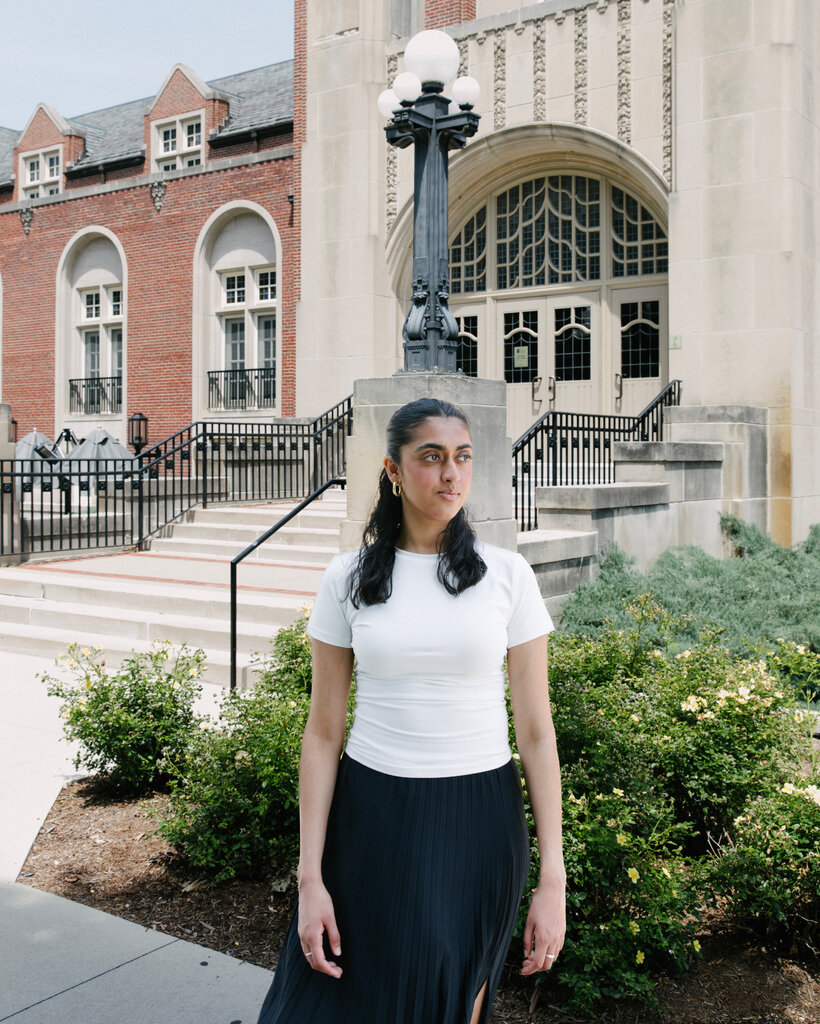
Manasi Mishra recently graduated from computer science at Pudu University. Madeleine Holdinski for The New York Times
Manasi Mishra, who grew up near Silicon Valley, remembers seeing in social media that the executives of technology enterprises called on students to learn programming.
“The saying of the year is that if you learn to program and try to get a degree in computer science, you can get a six-digit salary,” says a 21-year-old girl from St. Ramon, California.
These golden industry promises inspired Mishra to build her first website in primary school, to choose programming classes in high schools and to pursue computer studies in universities. However, she did not receive any notice of recruitment when she graduated from the Pudu University in May after a whole year of job search and internship.
“The only person I’ve got on the phone for my computer degree is Chipotle,” said Mishra in a TikTok video released this summer, “Get-ready-with-me”. This video has exceeded 147,000 times.
Starting in the early 2010s, many billion billionaires, technocrats and even the President of the United States encouraged young people to learn programming, claiming that technological skills both boosted employment prospects and boosted the economy. Technology companies have also pledged high salaries and various benefits to computer graduates.
“A start-up salary usually exceeds $100,000”, plus a $15,000 contract bonus and $50,000 worth of equities, which Microsoft executive Brad Smith claimed when he promoted the company’s computer education programme for secondary schools in 2012.
These opportunities for economic incentives and the development of popular applications have contributed rapidly to the education of computer programming and algorithms. According to data from the Association for Computer Research, a non-profit organization, the number of computer undergraduates in the United States exceeded 170,000 last year, more than double that of 2014. The Agency collects data from some 200 institutions of higher education each year.
But today, the proliferation of artificially intelligent programming tools that can quickly write thousands of computer codes, coupled with the downsizing of companies such as Amazon, Intel, Meta and Microsoft, has made this area, which has been advocated for years by technology leaders as a golden career ticket, less promising. This shift has disrupted the employment dreams of many newly graduated computer students and forced them to turn to other jobs.
A report by the Federal Reserve Bank of New York shows that among university graduates between 22 and 27 years of age, graduates in computer science and computer engineering face higher unemployment rates of 6.1 per cent and 7.5 per cent, respectively. This is more than twice as much as the unemployment rate among newly graduated students in biology and art history, which is only 3 per cent.
“I am very worried,” says Jeff Forbes, former Director of the Computer Science Education and Labour Development Project of the National Science Foundation of the United States. “A student in computer science who graduated three or four years ago could still receive a number of invitations from top companies, and now it is difficult for students of the same level to find work anywhere.”
In response to questions from The New York Times, more than 150 university students and current graduates from state schools such as Maryland University, Texas University, Washington University and private universities such as Cornell University and Stanford University shared their experiences. Some said that they had submitted hundreds or even thousands of applications to companies, non-profit organizations and government agencies for work in the science and technology category.
This process may be difficult, with technology companies requiring job seekers to complete an online programming assessment and well-performing people facing on-site programming tests and interviews. However, many computer graduates indicate that their months-long job search often ends with extreme disappointment, or even worse: companies do not respond directly.
Some have accused the science and technology industry of feeling “silent” career prospects. Job-seeking experience has also been described as “depressing” or “closing”.
Twenty-five-year-old Zach Taylor was one of them. He joined Oregon State University in 2019 to major in computer science, partly because he liked to write video games in high school. There seemed to be a lot of work in the technology industry.

Zach Taylor obtained a degree in computer science from Oregon State University in 2023 and has applied for nearly 6,000 scientific and technical jobs.
However, Taylor stated that since his graduation in 2023, he had applied for 5762 jobs in the scientific and technical categories. His efforts resulted in 13 interviews, without any full-time job.
He added that this job search was “one of the most frustrating things I had ever experienced”.
Computer graduates are now under stress, as technology companies are making extensive use of artificial intelligence programming assistants, which reduces the need for some companies to recruit junior software engineers. This trend is evident in the centre of San Francisco, where on billboards, artificial intelligence tools like CodeRabbit promote themselves to debug codes faster and better than humans.
“Unfortunately, the posts most likely to be replaced by automation, especially for newly graduated students, are the entry-level posts they want to apply for,” said Matthew Martin, a senior American economist at the Oxford Institute of Economics.
Trish Kemp, Executive Director of the Computer Research Association, said that students in computer science who graduated this year could be particularly hard hit, as many universities are only just beginning to develop the capacity of students to use artificially intelligent programming tools, the latest skills that technology companies now desire.
Some graduates say they’re trapped in an artificial intelligence “robate circle”. Many job-seekers now use professional artificial intelligence tools such as Simpson to customize their curricula vitae to specific jobs and automatically fill out application forms, so that they can quickly apply for many jobs. At the same time, companies flooded with large numbers of job-seekers use artificial intelligence systems to automatically scan curricula vitae and screen candidates.
Audrey Rohler, a data science student who had just graduated from Clark University in Worcester, Massachusetts, said that, in order to escape, she had highlighted her interpersonal skills, such as creativity, in her job application, and that her application had been written on her own, without the use of artificial smart chat robots. However, she stated that, on one occasion recently, she had received a rejection within three minutes of applying for work.
“Some companies use artificial intelligence to screen candidates and save the manpower chain”, Rohler, 22, said, “It is really hard to remain motivated when you realize that your livelihood will be determined by algorithms”.
Further obstacles have also been encountered in the search for government science and technology graduates.
Jamie Spori, who graduated from Georgetown University this year, said that her majoring in computers was because she liked to solve problems logically. During the university, she was also aware of the impact of artificial intelligence on the environment and was interested in science and technology policy.
Last summer, she worked in the National Science Foundation on national security and technology-related work, such as the supply of key minerals. She states that since then she has applied for more than 200 jobs in government, business and non-profit organizations.
She said, however, that the recent cuts in government spending and the hiring freeze had made access to federal government jobs more difficult, and that artificial intelligence programming tools had made access to company entry-level software more difficult.

Jamie Spley, a computer student who graduated from Georgetown University this year, has applied for more than 200 positions.
“The loss of opportunities because of artificial intelligence, which is discouraging,” Spori, 22 years old, grew up in Chicago, says. “But I think that artificial intelligence can offer new opportunities if we adapt and meet the challenges.”
Prominent computer education promoters are now turning to artificial intelligence. In 2017, President Trump had directed that federal funds be invested in computer science education in schools, and he had recently published a national plan of action for artificial intelligence, which included more students entering the field of artificial intelligence-related work.
As the main sponsor of computer education, Microsoft recently indicated that it would provide $4 billion worth of technology and funding for artificial intelligence training for students and workers. Last month, Microsoft Managing Director Smith indicated that the company was also assessing how artificial intelligence could change computer science education.